
Introducing the Queer Resilience Mascot
A story about survival, queerness, and refusing to give up

I’ve been meaning to share this story for a while, but haven’t found the time. This week, I have several heavier posts brewing, but wanted to share this because I think we could all use a little moment of hope and encouragement. And I think my old friend Cora, the one-winged cormorant, can help us with just that.
If you use the substack app or have logged into the website, you may have noticed the thumbnail image of a bird on my profile, who, when you look closer, you will see only has one wing.
I dabbled in photography for a few years, and for about a year, I spent hours of my weeks observing the great blue herons around one particular pond near my house. One morning, I spent 3 hours perched in the crook of a tree watching a heron preen and hunt. They’re awkward, prehistoric, beautiful birds—and they make truly horrible sounds. They fascinated me. I resonated with their strangeness and solitude.
At the beginning of June, as I was just coming out of that period, my attention shifted. I noticed a cormorant on a fallen tree that lies in the pond that had a very obviously broken wing. I watched for a while and thought “well that one sure isn’t going to last long,” but felt powerless to do much. A few days later, I noticed her again and decided to call the local wildlife rehab center. They affirmed that they weren’t able to help with cormorants or geese, and I affirmed that I could not do anything for this bird on my own.
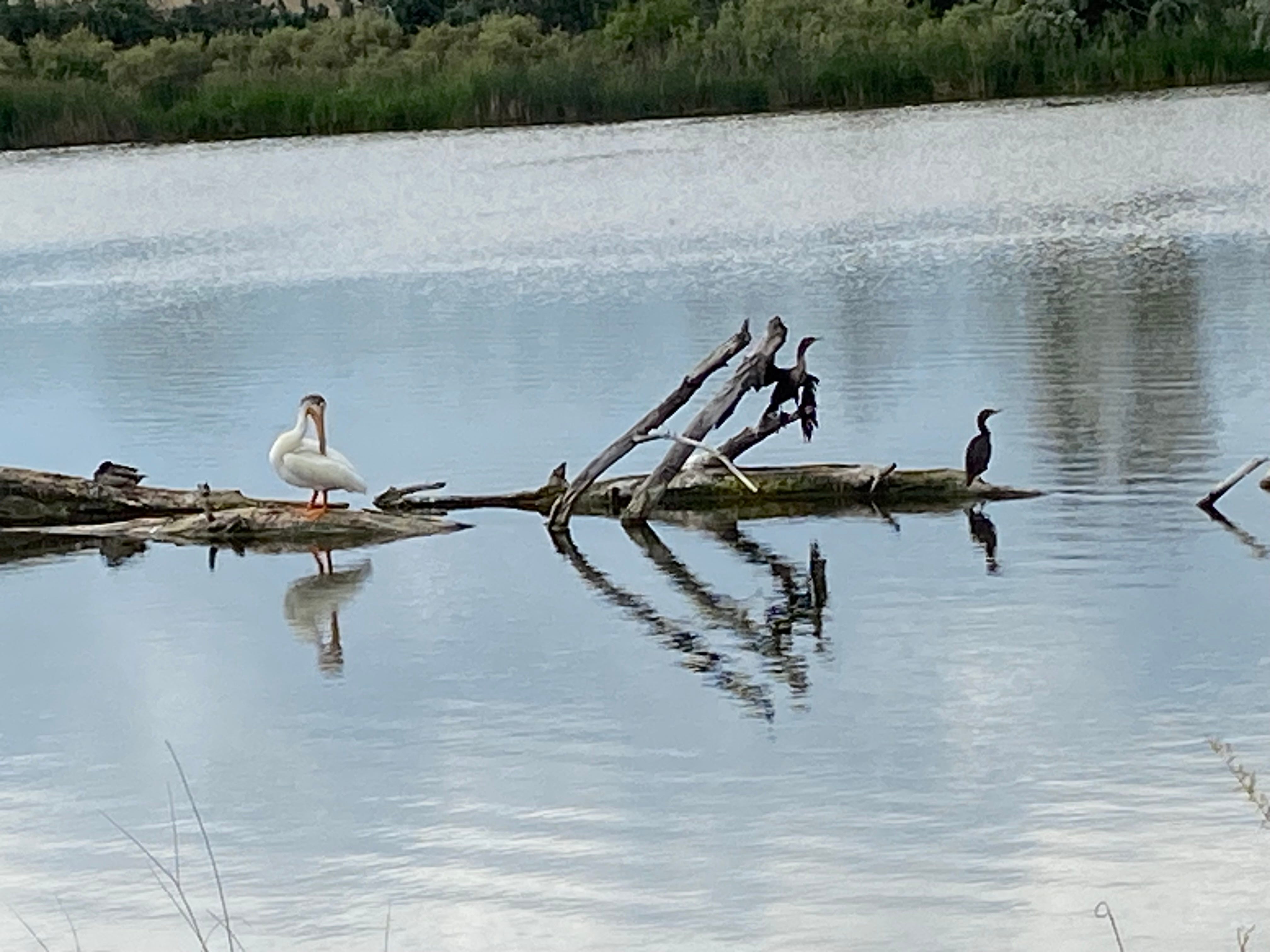
I visited the pond less over the next month because I was training for my fateful hike by going up to Boulder for a hike each morning. When I finally returned at the beginning of July, to my astonishment, the bird was still there, but now with the lower part of her wing entirely gone. Once again I thought “This bird is not long for this world.” At that point, I started going back down to the pond several times a week.


Cormorants aren’t shore-feeders like herons or grazers like ducks. They are diving birds, using their wings to steer underwater as they dive after fish. They rely on their wings to steer and yet, here she was, looking no worse for the wear than the other cormorants. I started calling her my mascot of the summer, amazed at her resilience, and completely missing the foreshadowing into my own journey.
Cormorants typically nest with each other. Cora was incapable of making herself a nest on the fallen tree and was left alone each night. In the mornings, her flock would return and they would swim, hunt, and sunbathe together. It was unbelievable to me that she was making it—she didn’t look any worse for the ware, and most other passersby didn’t even notice that she only had one full wing.
I was just getting into visiting and photographing Cora regularly when I became injured myself. “Well, fuck,” I thought, “I didn’t want her to literally become my mascot.” But there I was, 5 weeks non-weight bearing and on a knee scooter, and a cane for months after that. It was hard for me to visit Cora during that time, but I got out there as soon and as often as I reasonably could.
By November, I started to worry. She would not be able to survive a frozen pond. I thought about what I might be able to do to help her. I fantasized about sliding sushi out on a tray to her each day. Or getting a small boat to sit in and break up the ice each morning. Some mornings, I’d break the ice around the shore with my boots and throw rocks to create a bigger space but I knew that would only help for so long. By then, the rest of the cormorants had flown south and only Cora, and some occasional ducks, geese, or herons, remained on the pond.
One Friday afternoon, after two incredibly cold days in which the pond had completely frozen, I went down to the pond and searched for Cora. She wasn’t in her usual spot, which immediately worried me. Then I spotted Cora way over on the other side, on the walking path. She could see the river from there, which might give her better access to fish. She had survived this long doing things not-the-usual-way, and so maybe she could learn to hunt from shore instead of diving. Who knew?


I went down again on Saturday afternoon and much to my dismay, I could not find her anywhere. I walked and walked that small pond. Looking for places she might hide or for signs of predation. There were no signs of her—living or dead—anywhere. There had been days before when I couldn’t find her at first but if I waited long enough, I’d spot her in the brush along shore, or she’d show up on the pond, but this time I could not find her.
I went down again Sunday morning and this time ran into Ingrid, my fellow cormorant-watcher, who had seen Cora Saturday morning—on the walking path, seeming to be looking toward the river.
I never did see Cora again after that, but I also never saw any signs of predation, and I searched and searched. I choose to believe she hopped in the stream and went in search of warmer waters as her home had become untenable, stubbornly refusing to give up. In my mind, she made it all the way to the Gulf, where she found new waters and new companions.
Last week, many of my trans friends and clients started talking more seriously about leaving this country, as the water here is becoming untenable. We’ve adapted and survived as much as we can, but there comes a point where survival in place becomes impossible, and leaving becomes the only option.
While we don’t all know yet where we will go, how we will get there, or if we will even leave, Cora’s resilience—making it against all odds—gives me hope and strength as we move forward. It’s about surviving another day, another season, against odds that say you shouldn’t. It’s about adapting when survival means doing things differently than before.
That queer little one-winged bird gives me hope. And I hope she can give you a spark of it too.
Thanks for reading my queer little story in my queer little newsletter. I’d love to hear about someone or something that’s inspired you lately. Drop it in the comments for everyone to read. (And scroll down for more photos and videos of Cora)


Is it a cop-out to say your post inspired me? ☺️ I’m a birder, and your care and attention here for Cora are really lovely.
I’m so thrilled I just saw your recent post in the QStack chat and learned about your Substack. Really looking to reading more ❤️
What a sweet story, Nyle - I would say sad too, but I think animals for the most part are spared from self-pity, and Cora was a fighter so she may yet have found a sheltered spot for the winter.